
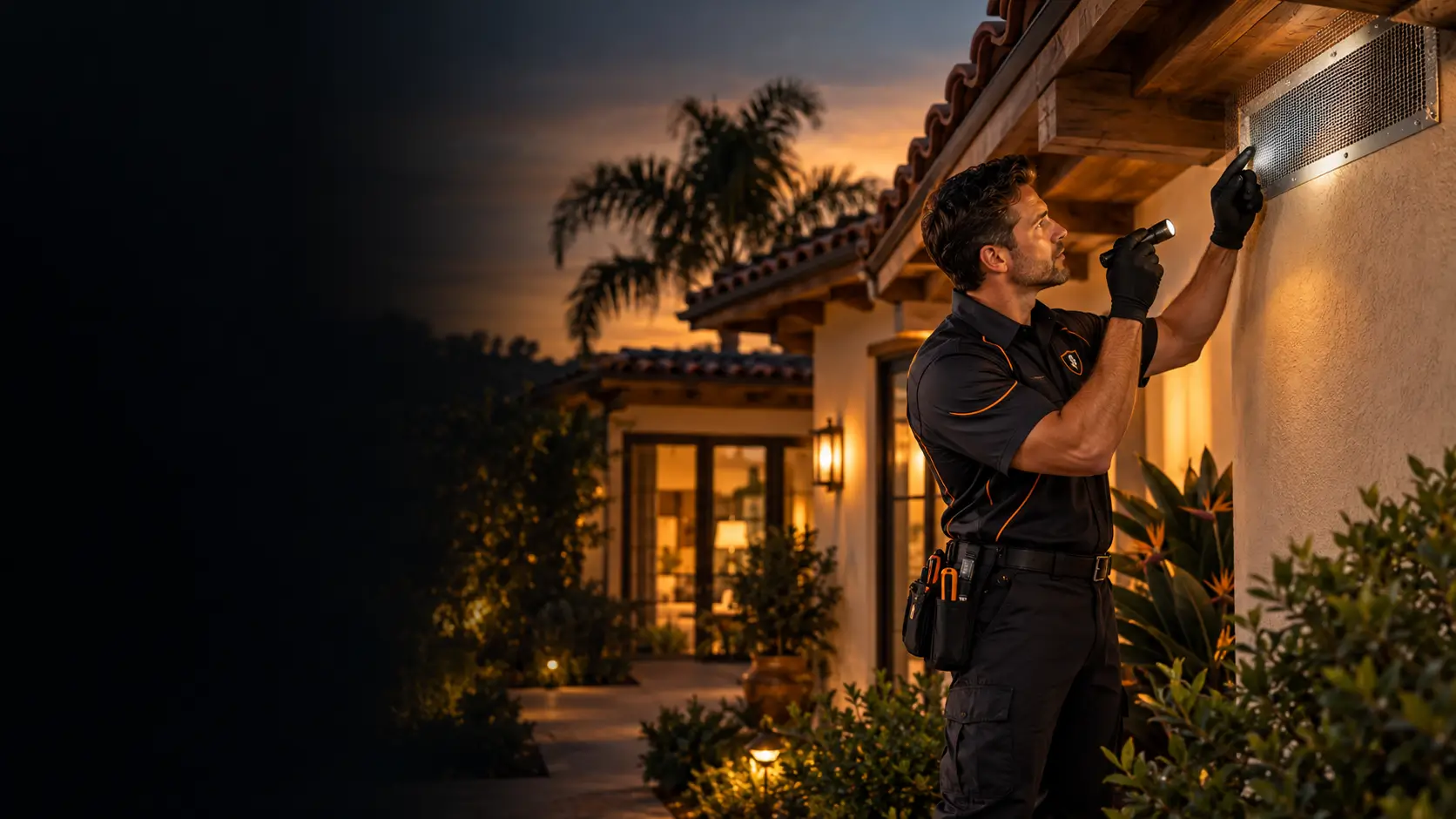
What Is Rodent Exclusion?
Rodent exclusion is the process of identifying and permanently sealing the structural openings that rodents use to enter a building. It is the single most important component of any effective rodent control program - because without exclusion, removal alone only provides temporary relief.
The concept is straightforward: if rodents cannot physically enter the structure, they cannot infest it. But the execution requires detailed knowledge of building construction, rodent behavior, and the specific materials needed to create barriers that rodents cannot compromise.
Every building has potential entry points. Rooflines, vents, utility penetrations, foundation joints, doors, and construction seams all create opportunities for rodents to enter. In Santa Barbara's older housing stock, many of these vulnerabilities have been present for decades and have never been addressed.
Why Exclusion Matters More Than Trapping
Most failed rodent control efforts fail because they focus entirely on removal without addressing entry. Setting traps inside a structure while leaving entry points open creates a cycle:
- Traps capture some of the existing rodent population
- Activity appears to decrease temporarily
- New rodents from the exterior environment find and use the same entry points
- Activity returns - often within weeks
- The homeowner repeats the trapping cycle, never addressing the root cause
Exclusion breaks this cycle permanently. Once all entry points are properly sealed with appropriate materials, the exterior rodent population can no longer access the interior of the structure. Combined with removal of any remaining interior population, this approach provides lasting results.
Common Entry Points We Seal
Through years of inspecting properties across Santa Barbara, these are the most frequently encountered rodent entry points:
Roofline and Upper Structure
- Roof-to-fascia gaps - Where the roof deck meets the fascia board, gaps routinely develop due to settling, warping, or construction tolerances. Roof rats access attics through these gaps regularly.
- Soffit openings - Damaged, missing, or improperly fitted soffit panels create access to the attic space from below the roof overhang.
- Attic vent screens - Gable vents, ridge vents, and turbine vents with damaged, corroded, or missing screens.
- Plumbing and electrical roof penetrations - Where pipes, conduit, or cables pass through the roof, gaps around the penetration often exist.
Walls and Mid-Structure
- Utility penetrations - Every point where a pipe, wire, cable, or duct passes through an exterior wall is a potential entry point.
- Weep holes - Drainage openings in stucco and masonry walls that are designed for moisture management but can also admit mice.
- AC line penetrations - The openings where refrigerant lines enter the building are frequently oversized and poorly sealed.
- Dryer vent terminations - Damaged or missing vent covers and flaps.
Foundation and Ground Level
- Foundation cracks - Cracks in concrete or masonry foundations that have widened enough for mice to pass through.
- Crawl space vents and doors - Damaged screens, displaced covers, and deteriorated access doors to crawl spaces.
- Garage door seals - Worn bottom seals, side gaps, and damaged weatherstripping on both single and double garage doors.
- Door thresholds - Gaps beneath exterior doors where sweeps are missing or worn.
Exclusion Materials and Methods
Effective exclusion requires materials that rodents cannot chew or gnaw through. This is a critical distinction - many homeowner attempts fail because they use materials like expanding foam, wood, or plastic that rodents can compromise within hours.
Professional exclusion materials include:
- Galvanized steel mesh / hardware cloth - Used to screen vents, cover large openings, and reinforce vulnerable areas. The mesh must be fine enough to exclude mice (6mm or smaller).
- Sheet metal and metal flashing - Used for roofline gaps, fascia repairs, and creating barriers at construction joints.
- Copper mesh - Used to fill smaller voids and gaps before sealing. Rodents avoid gnawing copper due to its texture.
- Concrete and mortar - Used for foundation crack repairs and filling masonry voids.
- Commercial-grade sealants - Used as finishing sealants over mesh and copper, and for sealing smaller gaps around utilities. Unlike consumer products, commercial sealants are formulated for durability and resistance to UV, temperature, and moisture.
The specific combination of materials depends on the location, size, and nature of each entry point. A roofline gap requires different treatment than a foundation crack or a utility penetration.
Our Exclusion Process
- Detailed inspection - We identify every potential and active entry point throughout the structure, documenting each location and the appropriate repair method.
- Priority assessment - Active entry points (those showing evidence of current use) are prioritized for immediate sealing.
- Material selection - We select appropriate materials for each entry point based on location, size, exposure, and the species involved.
- Professional sealing - Each entry point is sealed using the selected materials, with attention to both rodent resistance and aesthetic integration with the existing structure.
- Documentation - We document all work performed so you have a record of what was sealed and where.
- Verification - We verify that all identified entry points have been addressed and check for any additional vulnerabilities that may have been revealed during the work.
Exclusion vs. Proofing: Understanding the Difference
Rodent exclusion is a specific, structural intervention - sealing the physical openings in a building that rodents use to enter. Rodent proofing is a broader concept that includes exclusion work plus ongoing environmental management: vegetation control, food source reduction, property maintenance, and monitoring.
Think of exclusion as the structural component and proofing as the complete prevention strategy. Both are important for long-term results.
Ready to stop rodents from entering your property?
📞 Call (805) 429-3838 to Book Inspection